Many people think jasmine tea is simply green tea mixed with dried jasmine flowers. But authentic jasmine tea is created through a much more careful process.
Traditional jasmine tea is not flavored with jasmine oil or artificial aromas. It is naturally scented by layering fresh jasmine blossoms with tea leaves, allowing the leaves to slowly absorb the fragrance of the flowers.
The flowers are later removed, leaving behind a tea that carries the delicate aroma of jasmine within the leaf itself.
This process requires patience, timing, and experience. From selecting the green tea base to repeating the scenting process over several nights, every step influences the final aroma and taste of the tea.
Understanding how jasmine tea is made reveals why a well-crafted cup feels so different from ordinary jasmine-flavored tea.
Choosing The Green Tea Base
Before jasmine flowers ever meet the tea leaves, the foundation of jasmine tea is already determined.
Traditional jasmine tea usually begins with a green tea base because green tea leaves have a natural ability to absorb and hold fragrance. The leaves are typically harvested in early spring when they are young, tender, and rich in natural sweetness.
After harvesting, the tea goes through the standard green tea production process:
- Fixation: Heat is applied to stop oxidation and preserve the fresh character of the leaves.
- Rolling: The leaves are shaped and their internal structure is slightly broken to help release flavor.
- Drying: Moisture is removed, creating a stable tea that can be stored.
The finished green tea is then kept until summer, when jasmine flowers begin to bloom.
The quality of this base tea is essential. Jasmine adds aroma, but it cannot repair a poor-quality leaf. A good jasmine tea starts with a green tea that already has sweetness, freshness, and balance before the scenting process begins.
Harvesting Fresh Jasmine Blossoms
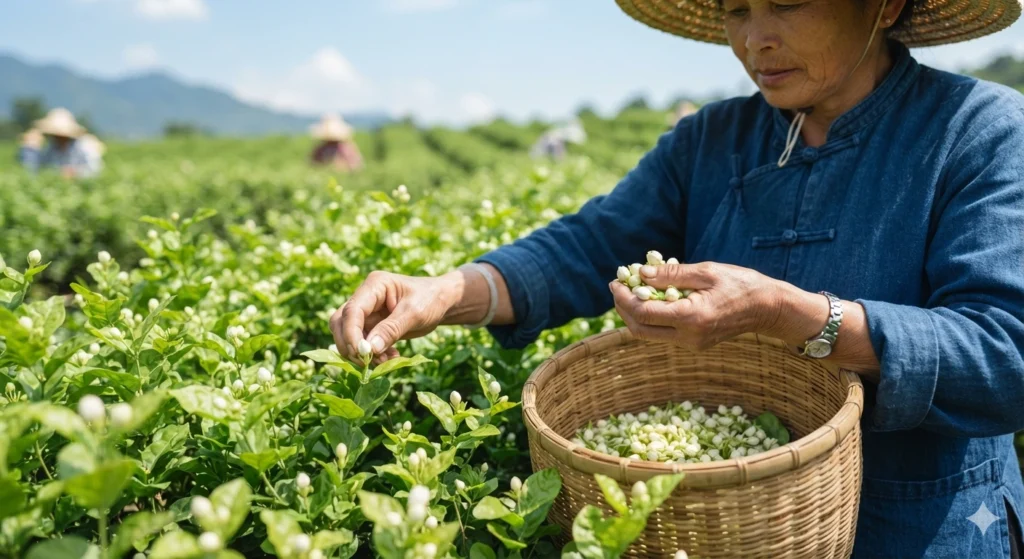
Jasmine flowers are the heart of the scenting process, and their harvest requires precise timing.
The flowers are usually picked during the day while the buds are still closed. At this stage, they contain the highest concentration of aromatic compounds and will release their fragrance when they naturally open at night.
Experienced workers select flowers carefully:
- Buds must be mature enough to open.
- Flowers must remain fresh and undamaged.
- Harvested blossoms must be handled gently to preserve their aroma.
The flowers are kept cool during the day and prepared for the evening scenting process.
Unlike many flowers, jasmine releases most of its fragrance after sunset. This natural rhythm is what makes traditional jasmine tea production such a time-sensitive craft.
The Traditional Jasmine Scenting Process
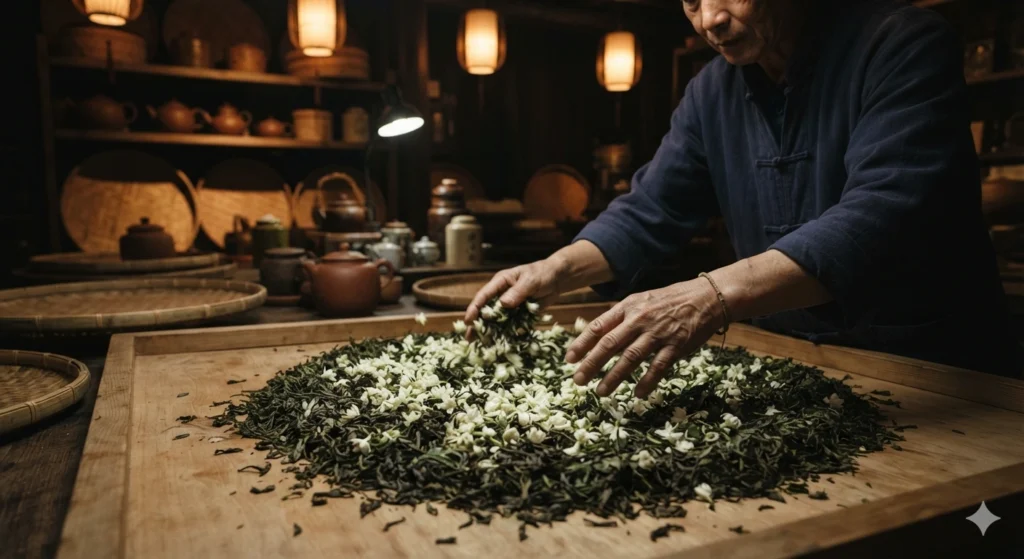
The most important stage of jasmine tea production happens at night.
As evening arrives, the jasmine buds begin to open and release their fragrance. The green tea leaves are spread into layers, and fresh jasmine blossoms are carefully mixed with the tea.
During this period, the dry tea leaves absorb the aromatic compounds released by the flowers.
The tea makers carefully control several conditions:
Temperature
The room must be warm enough for the flowers to open naturally, but not too hot. Excessive heat can damage the fragrance and create unwanted flavors.
Layer Thickness
The amount of jasmine flowers and tea must be balanced. Too many flowers can create uneven scenting, while too few may not provide enough aroma.
Timing
The flowers usually remain with the tea for several hours overnight. By morning, the blossoms have released much of their fragrance and begin to lose their freshness.
The result is not a tea covered with flower scent. It is a tea leaf that has gradually absorbed the character of jasmine.
Multiple Rounds Of Jasmine Scenting
High-quality jasmine tea is rarely scented only once.number of scenting rounds determines the [jasmine tea grades]
After the first night, the spent jasmine flowers are removed, and the tea is dried to remove moisture. Fresh jasmine blossoms are then added again for another round of scenting.
This process may be repeated several times depending on the quality of the tea.
Basic Jasmine Tea
Lower-cost jasmine teas may only receive one or two scenting rounds. They have a noticeable floral aroma, but the fragrance usually fades quickly.
Mid-Grade Jasmine Tea
Better-quality teas are often scented three to four times. The jasmine aroma becomes smoother and more integrated with the green tea base.
Premium Jasmine Tea
High-quality jasmine teas may undergo five, six, or even more scenting rounds. Each round uses fresh blossoms and adds another layer of fragrance.
The purpose of repeated scenting is not to make the tea stronger. It is to create balance. The jasmine should enhance the tea, not cover it.
Removing The Jasmine Flowers
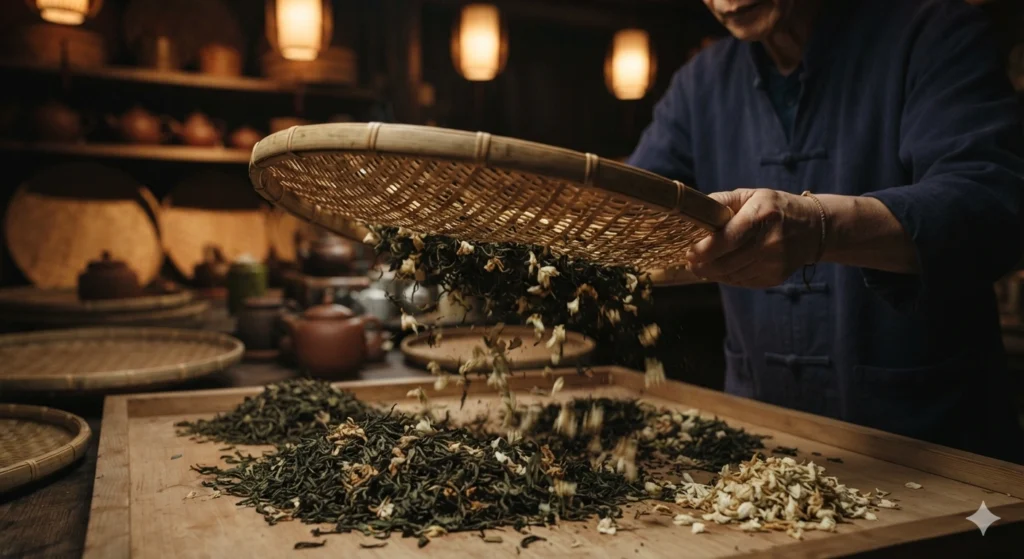
After the final scenting round, the jasmine blossoms are separated from the tea leaves.
This surprises many people because they expect premium jasmine tea to contain large amounts of dried flowers. In reality, the opposite is often true.
In traditional jasmine tea, the fragrance comes from the leaf itself.
The flowers have already completed their purpose during scenting. Leaving large amounts of petals in the finished tea often serves more as decoration than as an indicator of quality.
A beautiful jasmine tea is not defined by how many flowers you can see. It is defined by how naturally the leaf carries the aroma.
Drying And Finishing The Tea
After the final scenting round, the jasmine tea undergoes a final drying process.
This step removes any remaining moisture absorbed during the scenting process and helps stabilize the fragrance inside the tea leaves. The goal is not simply to dry the tea, but to preserve the balance between the fresh jasmine aroma and the natural character of the green tea.
Once the drying is complete, the tea is carefully sorted, packaged, and stored.
From the first spring harvest of the green tea leaves to the final scenting in summer, creating high-quality jasmine tea can take several months. What appears to be a simple floral tea is actually the result of careful timing, skilled craftsmanship, and a deep understanding of how tea leaves interact with flowers.
How Traditional Jasmine Tea Differs From Artificially Flavored Tea
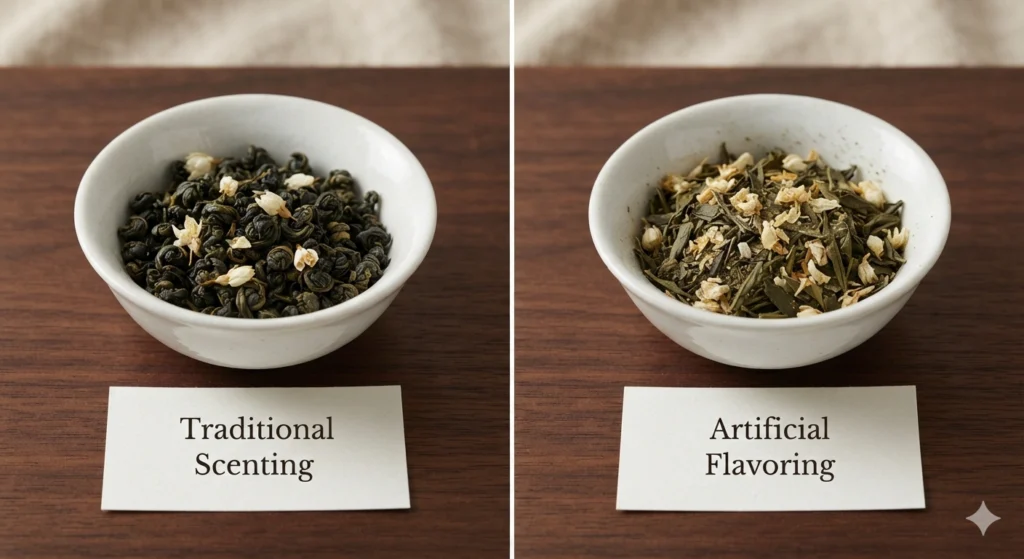
Not all jasmine teas are made in the same way.
Traditional jasmine tea relies on a natural scenting process, where fresh jasmine blossoms slowly transfer their aroma to the tea leaves. Artificially flavored jasmine tea, on the other hand, often uses jasmine oil or synthetic fragrance to create a stronger initial aroma.
The difference becomes clear when you taste the tea.
| Traditional Jasmine Tea | Artificial Jasmine Tea |
|---|---|
| Scented with fresh jasmine blossoms | Flavored with jasmine oils or artificial aromas |
| Soft, natural floral fragrance | Strong perfume-like aroma |
| Aroma develops across multiple infusions | Fragrance often fades quickly |
| Tea flavor remains clear and balanced | Tea base may taste flat or harsh |
| Fragrance comes from the leaf | Fragrance sits mainly on the surface |
A traditionally made jasmine tea does not overwhelm you with fragrance. Instead, the aroma feels integrated with the tea itself. The first infusion highlights the jasmine, while later infusions reveal more of the green tea underneath.
Artificially flavored teas often create a strong first impression but lack depth. The fragrance may disappear quickly, leaving behind a simple and sometimes harsh tea base.
This is why the traditional scenting process remains valuable. It creates harmony between the flower and the leaf rather than simply adding a floral smell.
How Many Times Is Jasmine Tea Scented?
The number of scenting rounds is one of the biggest differences between ordinary jasmine tea and premium jasmine tea.
The exact number depends on the quality of the tea, the production method, and the desired flavor profile.
Basic Jasmine Tea
Entry-level jasmine teas may be scented once or twice.
They usually have a noticeable floral aroma, but the fragrance may be lighter and disappear more quickly after brewing.
Medium-Quality Jasmine Tea
Better jasmine teas are often scented three to four times.
The aroma becomes smoother, and the relationship between the jasmine and the green tea base becomes more balanced.
Premium Jasmine Tea
High-quality jasmine teas may undergo five, six, or even seven scenting rounds.
Each round requires fresh jasmine flowers and another night of careful monitoring. The result is a deeper fragrance that remains present across multiple infusions.
The purpose of repeated scenting is not to make the tea smell stronger. It is to create a more natural and lasting connection between the jasmine blossom and the tea leaf.
Famous Jasmine Tea Production Regions
China has two regions especially known for jasmine tea production.
Fuzhou Jasmine Tea, Fujian Province
Fuzhou is considered the historical birthplace of traditional jasmine tea production.
For centuries, tea makers here have developed refined scenting techniques that emphasize elegance and balance. Fuzhou jasmine tea is known for its soft floral aroma, smooth green tea base, and layered fragrance.
The region’s traditional craftsmanship is closely connected with the repeated scenting process, where fresh jasmine blossoms are added night after night to create depth and complexity.
If you’d like to learn how traditional Fujian tea is produced, you can click the link to find out traditional scenting in [Fujian province]
Hengxian Jasmine Tea, Guangxi Province
Hengxian, now known as Hengzhou, is one of the largest jasmine-growing areas in China.
The warm climate allows jasmine flowers to thrive, making the region an important source of jasmine blossoms for tea production. Jasmine teas from Guangxi are often more abundant and affordable, with a fuller and more noticeable floral character.
Both regions produce excellent jasmine tea. Fuzhou is often associated with tradition and refinement, while Guangxi is recognized for its large-scale jasmine cultivation and floral intensity.
Frequently Asked Questions
How is jasmine tea made?
Jasmine tea is made by layering fresh jasmine blossoms with green tea leaves, allowing the leaves to absorb the natural fragrance of the flowers. After several hours, the flowers are removed, and the process may be repeated multiple times for higher-quality teas.
Is jasmine tea made from jasmine flowers?
No. Jasmine tea is made from tea leaves that are scented with jasmine blossoms. The flowers provide the aroma, but the tea itself comes from the Camellia sinensis plant.
Does jasmine tea contain real jasmine?
Traditional jasmine tea uses real jasmine flowers during production. However, most flowers are removed before packaging because the fragrance has already been absorbed into the tea leaves.
How long does it take to make jasmine tea?
The process can take several months. The green tea base is usually produced in spring, while jasmine scenting takes place during the summer flowering season. Premium teas may require multiple scenting rounds over several nights.
Is jasmine tea naturally flavored?
Traditional jasmine tea is naturally scented, not artificially flavored. The aroma comes from fresh jasmine blossoms interacting with tea leaves during the scenting process.
The Craft Behind Every Cup Of Jasmine Tea
Jasmine tea is a reminder that some things cannot be rushed.
The fragrance in a good cup of jasmine tea does not come from adding more flavor. It comes from patience, timing, and the careful meeting of two natural elements: the tea leaf and the jasmine flower.
At Tea Passage, we look for jasmine teas made through traditional scenting methods, where the floral aroma is naturally absorbed into the leaf. The result is a tea that feels balanced, elegant, and connected to the centuries-old craft behind it.
A truly memorable jasmine tea does not simply smell like jasmine. It tells the story of how jasmine and tea became one.